Reinforcement Learning Courses
Reinforcement Learning courses can help you learn key concepts like Markov decision processes, reward systems, and policy optimization. You can build skills in algorithm design, simulation environments, and evaluating agent performance. Many courses introduce tools such as TensorFlow and OpenAI Gym, that support implementing and testing reinforcement learning algorithms in practical scenarios.
Popular Reinforcement Learning Courses and Certifications
University of Alberta

University of Colorado Boulder
Skills you'll gain: Reinforcement Learning, Deep Learning, Machine Learning Methods, Artificial Intelligence and Machine Learning (AI/ML), Markov Model, Responsible AI, Computational Logic, Machine Learning Algorithms, Artificial Neural Networks, Model Optimization, Theoretical Computer Science, Model Evaluation, Model Training, Algorithms, Probability, Applied Machine Learning, Functional Specification, Applied Mathematics, Debugging
University of Alberta
Skills you'll gain: Reinforcement Learning, Machine Learning, Machine Learning Algorithms, Artificial Intelligence, Markov Model, Algorithms
DeepLearning.AI
Skills you'll gain: Unsupervised Learning, Artificial Intelligence and Machine Learning (AI/ML), Applied Machine Learning, Responsible AI, Machine Learning, Supervised Learning, Artificial Intelligence, Reinforcement Learning, Artificial Neural Networks, Deep Learning, Anomaly Detection, Model Optimization, Dimensionality Reduction

Skills you'll gain: PyTorch (Machine Learning Library), Reinforcement Learning, Deep Learning, Model Optimization, Large Language Modeling, Artificial Intelligence and Machine Learning (AI/ML), Artificial Neural Networks, Model Training, Machine Learning Algorithms, Machine Learning, Python Programming, Natural Language Processing, Performance Tuning, Algorithms, Model Evaluation, Data Analysis
What brings you to Coursera today?

Skills you'll gain: Autoencoders, Recurrent Neural Networks (RNNs), Convolutional Neural Networks, Reinforcement Learning, Generative Adversarial Networks (GANs), Generative Model Architectures, Deep Learning, Unsupervised Learning, Transfer Learning, Model Optimization, Artificial Neural Networks, Machine Learning, Dimensionality Reduction, Model Training

MathWorks
Skills you'll gain: Reinforcement Learning, Artificial Intelligence and Machine Learning (AI/ML), Artificial Neural Networks, Control Systems
DeepLearning.AI
Skills you'll gain: Fine-tuning, Large Language Modeling, Model Training, Model Evaluation, Reinforcement Learning

New York University
Skills you'll gain: Supervised Learning, Machine Learning Methods, Model Evaluation, Reinforcement Learning, Applied Machine Learning, Machine Learning Algorithms, Statistical Methods, Dimensionality Reduction, Unsupervised Learning, Artificial Neural Networks, Decision Tree Learning, Predictive Modeling, Financial Trading, Model Training, Machine Learning, Financial Market, Derivatives, Markov Model, Finance, Tensorflow
Skills you'll gain: Reinforcement Learning, Artificial Intelligence and Machine Learning (AI/ML), Deep Learning, Model Optimization, Model Training, Model Evaluation

New York University
Skills you'll gain: Reinforcement Learning, Financial Trading, Derivatives, Markov Model, Financial Modeling, Securities Trading, Portfolio Management, Market Dynamics, Machine Learning


Columbia University
Skills you'll gain: Reinforcement Learning, Machine Learning, Algorithms, Markov Model, Deep Learning
Best free Reinforcement Learning courses
High-quality free Reinforcement Learning courses you can start today.
- Reinforcement LearningMathWorksBeginner1 - 4 WeeksFree
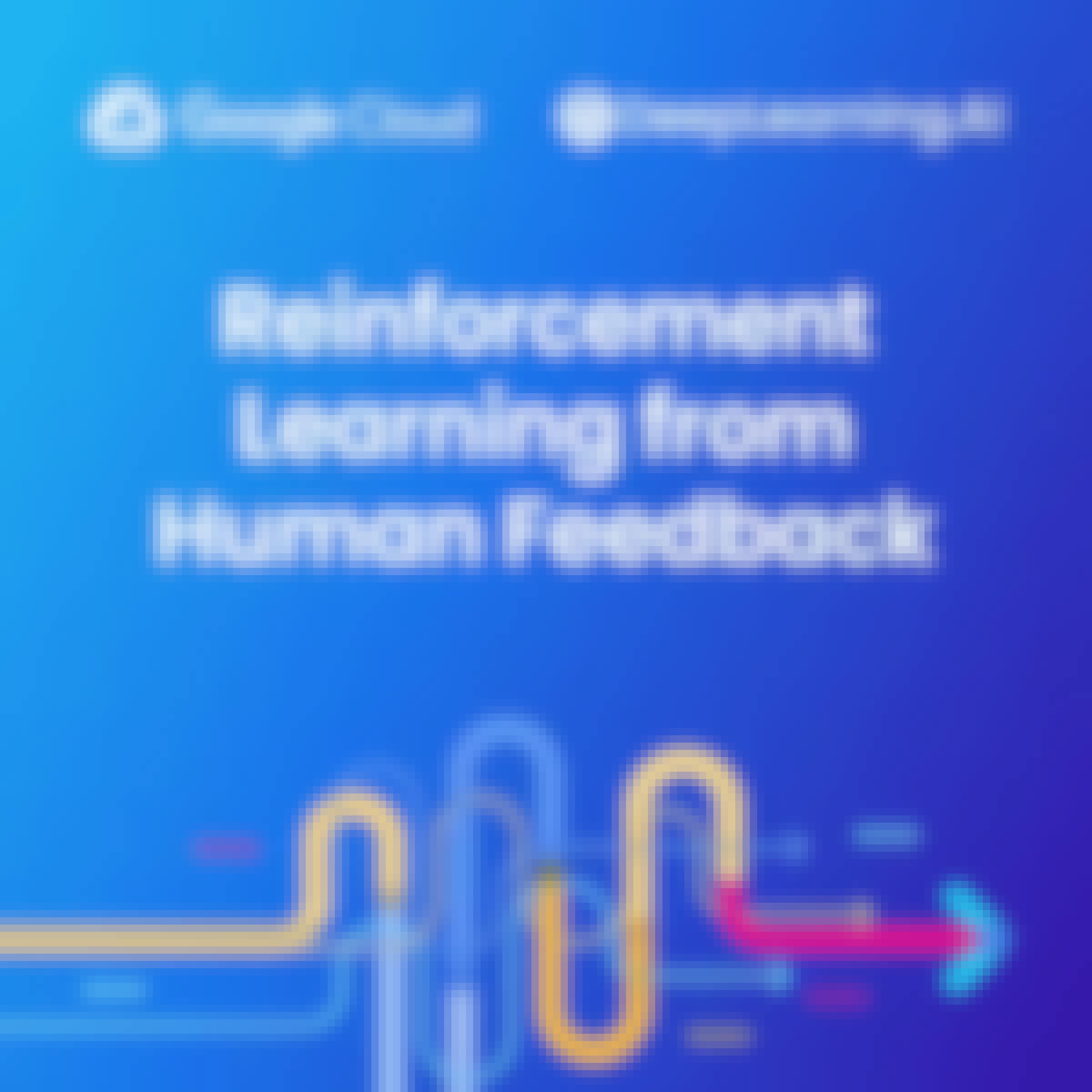
- Reinforcement Learning from Human FeedbackDeepLearning.AIIntermediateLess Than 2 HoursFree
Best Reinforcement Learning courses from University of Alberta
Top-rated Reinforcement Learning courses offered by University of Alberta on Coursera.
- Reinforcement LearningUniversity of AlbertaIntermediateUniversity of Alberta
- Fundamentals of Reinforcement LearningUniversity of AlbertaIntermediate1 - 3 MonthsUniversity of Alberta
Best Reinforcement Learning certificate programs
Earn a certificate in Reinforcement Learning from top universities and companies.
- Foundations of Reinforcement LearningUniversity of Colorado BoulderIntermediate3 - 6 MonthsSpecialization
- Deep Reinforcement Learning Hands-OnPacktIntermediate3 - 6 MonthsSpecialization
- Machine Learning and Reinforcement Learning in FinanceNew York UniversityIntermediate3 - 6 MonthsSpecialization










